Difference Between Spread Betting and CFD Trading: UK Guide (2026)
By Phillip Ashdown · Published · Updated · 11 min read
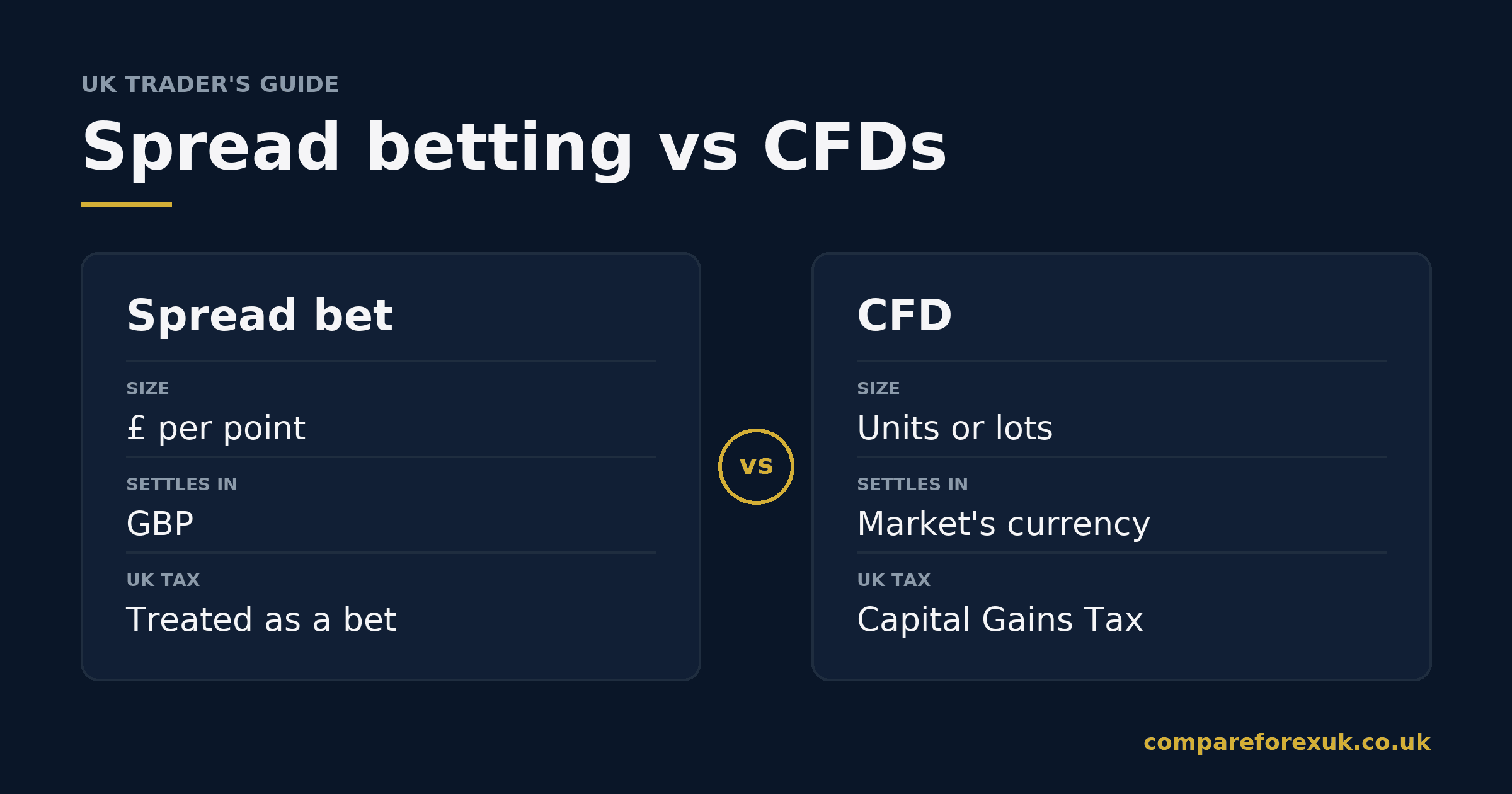
The main difference between spread betting and CFD trading is tax. For most UK individuals, spread betting profits are free of Capital Gains Tax, while CFD profits are taxable, although CFD losses can be offset against other gains. The two also differ in how you size a trade (pounds per point versus units or lots), which currency profits settle in, and which platforms support them.
Spread betting and CFD trading let you speculate on the same markets, with the same leverage limits and the same FCA protections. The differences are in the wrapper. A spread bet is sized in pounds per point and legally treated as a bet, so profits are normally free of Capital Gains Tax. A CFD is sized in contracts, settles in the market's own currency, and is taxed as a capital gain, which also means losses can be offset. Neither is better in general: the right one depends on your tax position, the platform you want to use and how you prefer to size trades.
Key takeaways
| Point | Details |
|---|---|
| Same markets, same protections | Both are leveraged derivatives covered by the FCA's retail rules: leverage caps, a 50% margin close-out and negative balance protection. |
| Sizing differs | Spread bets are staked in £ per point; CFDs are traded in units or lots of the underlying. |
| Profit currency differs | Spread bet profits and losses are always in pounds; CFD profits land in the instrument's currency and may need converting. |
| Tax differs | Spread betting profits are normally tax-free; CFD profits fall under Capital Gains Tax, but CFD losses can be offset. |
| Platforms differ | Several brokers offer MetaTrader for CFDs only, so check platform support for spread betting specifically. |
| Availability differs | Spread betting is a UK and Ireland product; CFDs are offered far more widely. |
What is spread betting?
A spread bet is an agreement with a broker to win or lose a set amount for every point a market moves. You choose a stake, say £5 per point, and a direction. If you buy and the market rises 40 points, you make £200; if it falls 40 points, you lose £200. You never own the underlying currency, share or index.
Spread bets come in two main forms. Daily funded bets stay open until you close them, with an overnight funding charge or credit applied each day. Quarterly (forward) bets have a fixed expiry date, with the funding cost built into a wider spread instead. Financial spread betting is regulated by the FCA and is offered almost exclusively to UK and Irish residents. A common misconception is that spread bets always have a fixed expiry and CFDs don't: in practice most spread bets are daily funded with no expiry, just like most CFDs.
New to spread betting? Our guide to what spread betting is and how it works covers pricing, margin and costs with worked examples.
What is a CFD?
A contract for difference (CFD) is an agreement to exchange the difference in an asset's price between when you open and close the position. Instead of a stake per point, you trade a quantity: a number of shares, index units or, for forex, lots (one standard lot is 100,000 units of the base currency).
Your profit or loss is calculated in the instrument's own currency. A EUR/USD CFD settles in US dollars, which your broker then converts to your account currency. CFDs are offered by FCA-regulated brokers in the UK and by regulated firms in many other countries, which is one reason MetaTrader and other third-party platforms support them more widely than spread bets.
How do spread betting and CFDs compare?
| Spread betting | CFD trading | |
|---|---|---|
| Legal treatment | A bet | A derivative contract (financial future for tax) |
| How you size a trade | £ per point | Units, shares or lots |
| Currency of profit and loss | Always GBP | The instrument's currency, converted to your account currency |
| UK tax on profits | Normally exempt from CGT and Income Tax | Capital Gains Tax above the £3,000 allowance |
| Losses for tax | Can't be offset | Can be offset against other gains |
| Stamp duty | None | None |
| Leverage limits (FCA retail) | Same caps, from 30:1 down to 5:1 | Same caps, from 30:1 down to 5:1 |
| Negative balance protection | Yes | Yes |
| Costs | Mainly spread plus overnight funding | Spread, overnight funding and, on shares, often commission |
| Expiry | Daily funded (no expiry) or quarterly | Usually no expiry; some brokers offer futures-based CFDs |
| Who can open an account | Mainly UK and Irish residents | Widely available internationally |
| Third-party platforms | Varies; MetaTrader often CFD-only | MetaTrader, cTrader and TradingView widely supported |
What does the same trade look like as a spread bet and a CFD?
The clearest way to see the difference is to place one idea both ways. Say you expect EUR/USD to rise from 1.1650 to 1.1700, a move of 50 points (pips). For simplicity, assume GBP/USD is 1.3500, the FCA's 30:1 retail cap on a major pair (3.33% margin), and ignore the spread for now.
| Spread bet: £10 per point | CFD: 1 standard lot (100,000 EUR) | |
|---|---|---|
| Value of a 1-point move | £10 | $10 (about £7.41) |
| Position exposure | £116,500 (11,650 points × £10) | $116,500 (about £86,300) |
| Margin required at 30:1 | about £3,883 | about £2,877 |
| Result of a 50-point rise | +£500 | +$500, about +£370 once converted |
| Spread cost at 0.6 points | £6 | $6, about £4.44 |
Three things stand out:
- The spread bet is simpler to size in pounds. You know exactly what each point is worth before you trade, with no currency conversion.
- The CFD result depends on the exchange rate. If GBP/USD moved while the trade was open, the sterling value of that $500 would change too. Some brokers let you hold a USD account to avoid converting every trade.
- These two positions aren't the same size. To match 1 lot, you'd stake about £7.41 per point. Comparing the two products means comparing equivalent exposure, not equivalent-looking numbers. Our pip value calculator shows the matching stake per point for any lot size.
These figures are an illustration only; real spreads, margin and conversion rates vary by broker and market conditions.
How are spread betting and CFDs taxed?
HMRC treats the two products differently. Its Capital Gains Manual states that no chargeable gains or allowable losses arise from spread betting (CG56105), so for most UK individuals profits are free of Capital Gains Tax and Income Tax, and nothing goes on a tax return. Retail CFDs are classed as financial futures (CG56100) and fall under Capital Gains Tax: 18% or 24% on gains above the £3,000 annual allowance in 2026/27.
The trade-off is losses. A CFD loss can be offset against other capital gains and carried forward, while a spread betting loss can't be used at all. Two examples show how much this can matter.
Tax example 1: a profitable year
You make a £10,000 trading profit in the 2026/27 tax year, have no other capital gains, and are a higher-rate taxpayer.
| As spread bets | As CFDs | |
|---|---|---|
| Trading profit | £10,000 | £10,000 |
| Annual exempt amount | Not relevant | −£3,000 |
| Taxable gain | £0 | £7,000 |
| Capital Gains Tax at 24% | £0 | £1,680 |
A basic-rate taxpayer with enough of the £37,700 basic rate band unused would pay 18% on the CFD gain instead, which is £1,260.
Tax example 2: a losing year
You lose £5,000 trading, and in the same tax year you make an £8,000 gain selling shares held outside an ISA. You are a higher-rate taxpayer.
| Loss made on spread bets | Loss made on CFDs | |
|---|---|---|
| Gain on shares | £8,000 | £8,000 |
| Trading loss offset | £0 (not allowed) | −£5,000 |
| Annual exempt amount | −£3,000 | −£3,000 |
| Taxable gain | £5,000 | £0 |
| Capital Gains Tax at 24% | £1,200 | £0 |
In other words, spread betting is more tax-efficient when you win, and CFDs are more tax-efficient when you lose and have other gains to set the loss against. Unused CFD losses can also be carried forward to future years if you report them to HMRC.
These examples use 2026/27 rates and allowances and are simplified illustrations, not tax advice. Tax treatment depends on your individual circumstances and can change, so take professional advice if tax is a deciding factor.
What costs apply to each?
The cost structure is broadly similar, but there are a few differences worth checking on any broker's fee page:
- Spread: the main cost on both. Many brokers quote the same headline spread for spread bets and CFDs on the same market.
- Commission: share CFDs often carry a commission per trade, while share spread bets are more commonly priced through the spread alone. Forex is usually spread-only on standard accounts for both, though raw-spread CFD accounts add a commission instead.
- Overnight funding: charged (or occasionally credited) on daily funded spread bets and on CFDs held past the daily cut-off. Quarterly spread bets build this cost into a wider spread instead.
- Currency conversion: applies to CFDs when the instrument's currency differs from your account currency. Spread bets avoid it because everything is priced in pounds. Our guide to how Fed interest rate decisions affect gold shows how this plays out on an XAU/USD trade.
- Guaranteed stop premium and inactivity fees: broker-specific, and apply to either product where offered.
If you mainly trade currencies, our forex spread betting comparison shows each broker's published spreads on the major pairs side by side.
Are leverage limits and protections the same?
Yes. The FCA's permanent retail rules, introduced in 2019, apply to CFDs, spread bets and rolling spot forex alike (PS19/18). For retail clients that means:
| Market | Maximum leverage | Minimum margin |
|---|---|---|
| Major currency pairs | 30:1 | 3.33% |
| Non-major pairs, gold, major indices | 20:1 | 5% |
| Other commodities, non-major indices | 10:1 | 10% |
| Individual shares | 5:1 | 20% |
On top of the leverage caps, brokers must close positions when your equity falls to 50% of the required margin, provide negative balance protection so you can't lose more than your account balance, and display a standardised risk warning with the share of retail accounts that lose money. Crypto CFDs and spread bets can't be offered to UK retail clients at all under a separate FCA ban.
Both products are offered by the same FCA-authorised firms, so client money segregation and eligibility for the Financial Services Compensation Scheme depend on the firm, not the product. Always check the entity on the FCA register before opening an account.
Which platforms support spread betting?
This is where the two products differ most in practice. CFDs are supported almost everywhere, including MetaTrader 4, MetaTrader 5, cTrader and TradingView. Spread betting support is patchier, because it's a UK-specific product and not every platform or broker enables it.
From our own broker research:
- Pepperstone offers spread betting across its full platform range, including MT4, MT5, cTrader and TradingView.
- Trade Nation runs spread betting on its own platform and TradingView, but MT4 is available for CFDs only.
- Spreadex offers spread betting and CFDs from one account, with TradingView as its only third-party platform (no MetaTrader).
- FxPro runs spread betting on a dedicated platform, FxPro Edge, separate from its CFD platforms.
If you rely on a specific platform, expert advisors or indicators, confirm that the platform supports the spread betting account before opening one, not just the CFD account. Our comparison of UK spread betting brokers sets out platform support for each broker side by side.
Which one is right for you?
There's no universal answer, but a few questions usually settle it:
- Do you have other capital gains in the year? CFD losses can reduce tax on gains elsewhere; spread betting losses can't.
- Do you want to think in pounds per point? Spread bets make position sizing and profit and loss simpler for GBP-based traders.
- Which platform do you want to use? If you rely on MetaTrader, check whether your broker supports it for spread betting.
- Where do you live? Spread betting is generally only available to UK and Irish residents. If you might move abroad, a CFD account may be easier to keep.
- Do you trade individual shares? Compare the commission on share CFDs with the spread on the equivalent spread bet at your chosen broker.
Whichever you choose, the underlying risk is the same: both are leveraged, and most retail accounts lose money.
Can you have both a spread betting and a CFD account?
Yes. Many UK brokers offer both, sometimes from a single login. Some traders use a CFD account for certain markets or platforms and a spread betting account for others. If you do, keep clear records of which trades were made in which account, because only the CFD trades are relevant to Capital Gains Tax.
Compare FCA-regulated brokers with CompareForexUK
Spread betting and CFDs are two routes to the same markets, and the right broker matters as much as the right product. Our spread betting broker comparison covers spreads, minimum deposits, platforms and risk management for brokers offering both products, and our best forex brokers guide compares FCA-regulated brokers on all-in cost.
This article contains affiliate links. CompareForexUK earns a commission when you open an account through a referral link, at no additional cost to you. Commercial relationships can affect which brokers we feature and where they appear.
This article is for general information only and does not constitute financial or tax advice. Spread bets and CFDs are complex instruments and come with a high risk of losing money rapidly due to leverage. The majority of retail investor accounts lose money when trading spread bets and CFDs. You should consider whether you understand how these products work and whether you can afford to take the high risk of losing your money.
Frequently asked questions
Is spread betting better than CFD trading?
Neither is better for everyone. Spread betting usually suits UK taxpayers who expect to make a profit and want to size trades in pounds, because profits are normally free of Capital Gains Tax. CFDs can suit traders with other capital gains to offset losses against, those who need MetaTrader or another platform that only supports CFDs, and anyone who may move abroad.
Is a CFD a bet?
No. A spread bet is legally a bet, which is why HMRC does not charge Capital Gains Tax on it. A CFD is a contract to exchange the difference in an asset's price, and HMRC treats retail CFDs as financial futures (CG56100), so gains and losses fall under Capital Gains Tax. Both are regulated by the FCA as financial products.
What is the main difference between spread betting and CFD trading?
Both let you speculate on price movements with leverage and without owning the asset. A spread bet is staked in pounds per point and legally treated as a bet, so profits are normally free of UK Capital Gains Tax. A CFD is traded in units or lots, settles in the instrument's currency and is taxed as a capital gain, which also allows losses to be offset.
Is spread betting tax-free in the UK?
For most UK individuals, yes. HMRC's Capital Gains Manual (CG56105) states that no chargeable gains or allowable losses arise from spread betting, so profits aren't subject to Capital Gains Tax. The flip side is that spread betting losses can't be offset against other gains. Tax treatment depends on individual circumstances and can change.
Is spread betting or CFD trading cheaper?
Neither is consistently cheaper. Many brokers quote the same spread for both on the same market. CFDs can add commission on shares and currency conversion when the instrument isn't priced in your account currency, while spread bets are priced in pounds. Compare the all-in cost for your own trade size at your chosen broker.
Are leverage limits the same for spread bets and CFDs?
Yes. The FCA's retail rules apply to both: up to 30:1 on major currency pairs, 20:1 on non-major pairs, gold and major indices, 10:1 on other commodities and non-major indices, and 5:1 on individual shares. Both also carry a 50% margin close-out and negative balance protection.
Can I use MetaTrader for spread betting?
Sometimes. Several brokers offer MT4 or MT5 for CFD accounts only, while others, such as Pepperstone, support spread betting on MetaTrader too. Check that your preferred platform supports the spread betting account specifically before you open one.
Can non-UK residents open a spread betting account?
Generally not. Financial spread betting is offered almost exclusively to UK and Irish residents. CFDs are offered by regulated brokers in many other countries, so they're the more portable option if you might move abroad.
Sources
- HMRC Capital Gains Manual CG56105: financial spread betting
- HMRC Capital Gains Manual CG56100: contracts for differences
- GOV.UK: Capital Gains Tax rates and allowances
- FCA PS19/18: restricting CFD products sold to retail clients
- FCA: crypto ETNs and the retail cryptoasset derivatives ban
- FCA Financial Services Register
- Financial Services Compensation Scheme (FSCS)