What Is Spread Betting? How It Works in the UK (2026 Guide)
By Phillip Ashdown · Published · Updated · 14 min read
Spread betting is a way to speculate on the price of a financial market, such as the FTSE 100, a currency pair, gold or a company's shares, without buying the market itself. You decide whether the price will rise or fall and choose how much to stake for every point it moves. Get the direction right and you make your stake multiplied by the points gained. Get it wrong and you lose the same way.
It is a distinctly British product. In the UK it can only be offered to retail clients by firms authorised by the Financial Conduct Authority (FCA), and for most individuals the profits are free of Capital Gains Tax. It is also leveraged, which is why most retail accounts lose money. This guide explains how spread betting works, what it really costs, how it is taxed and regulated, and the risks, using worked examples in pounds per point.
Spread betting at a glance
| Question | Short answer |
|---|---|
| What you trade | The price movement of a market, not the asset itself |
| How a bet is sized | A stake in £ per point, for example £2 per point |
| Direction | Buy if you think the price will rise, sell if you think it will fall |
| Main cost | The spread between the buy and sell price, plus overnight funding on positions held overnight |
| Leverage | You put down margin, from 3.33% to 20% of the position for most retail markets |
| UK tax | Normally no Capital Gains Tax or stamp duty; losses cannot be offset |
| Regulator | The FCA, under its retail CFD rules that also cover spread bets |
| Risk | High: at the brokers we compare, 61% to 74% of retail accounts lose money |
Financial spread betting vs sports spread betting
Search for "spread betting" and you will find two different products. Sports spread betting lets you bet on outcomes such as the number of goals in a match, and it is overseen by the Gambling Commission. Financial spread betting, the subject of this guide, is a bet on the price of a financial market, and it is regulated by the FCA as a financial product. The mechanics are similar, a buy price, a sell price and a stake per point, but the markets, the rules and the protections are not.
Financial spread betting began in the UK. IG Index, now IG Group, was founded in 1974 by Stuart Wheeler and is generally credited as the first firm to offer it, initially as a way to bet on the price of gold at a time when exchange controls made buying physical gold difficult. Today it covers thousands of markets, from indices and currencies to commodities and individual shares.
How spread betting works
Every spread betting market has two prices. The buy price is the one you deal at if you think the market will rise. The sell price, which is slightly lower, is the one you deal at if you think it will fall. The gap between them is the spread, and it is how the provider is mainly paid.
A spread bet has three ingredients:
- Direction. Buying is often called going long; selling is going short. Being able to profit from a falling market is one of the main differences from buying shares.
- Stake per point. You choose how many pounds you win or lose for each point the market moves, for example £1, £2 or £10 per point.
- Points. A point is the unit your stake is multiplied by. On the FTSE 100 one point is one index point; on UK shares it is usually one penny; on GBP/USD it is usually 0.0001, the fourth decimal place.
Your profit or loss is simply: points moved in your favour (or against you) × stake per point. Because you open at one side of the spread and close at the other, the market has to move by at least the spread before a position breaks even.
To work backwards from the amount you are prepared to lose, divide it by your stop distance in points: risking £50 with a 25-point stop gives a stake of £2 per point. The spread bet mode of our position size calculator does this for forex, gold and the major indices.
Worked examples
The prices below are illustrative and exclude overnight funding unless stated.
Example 1: buying the FTSE 100
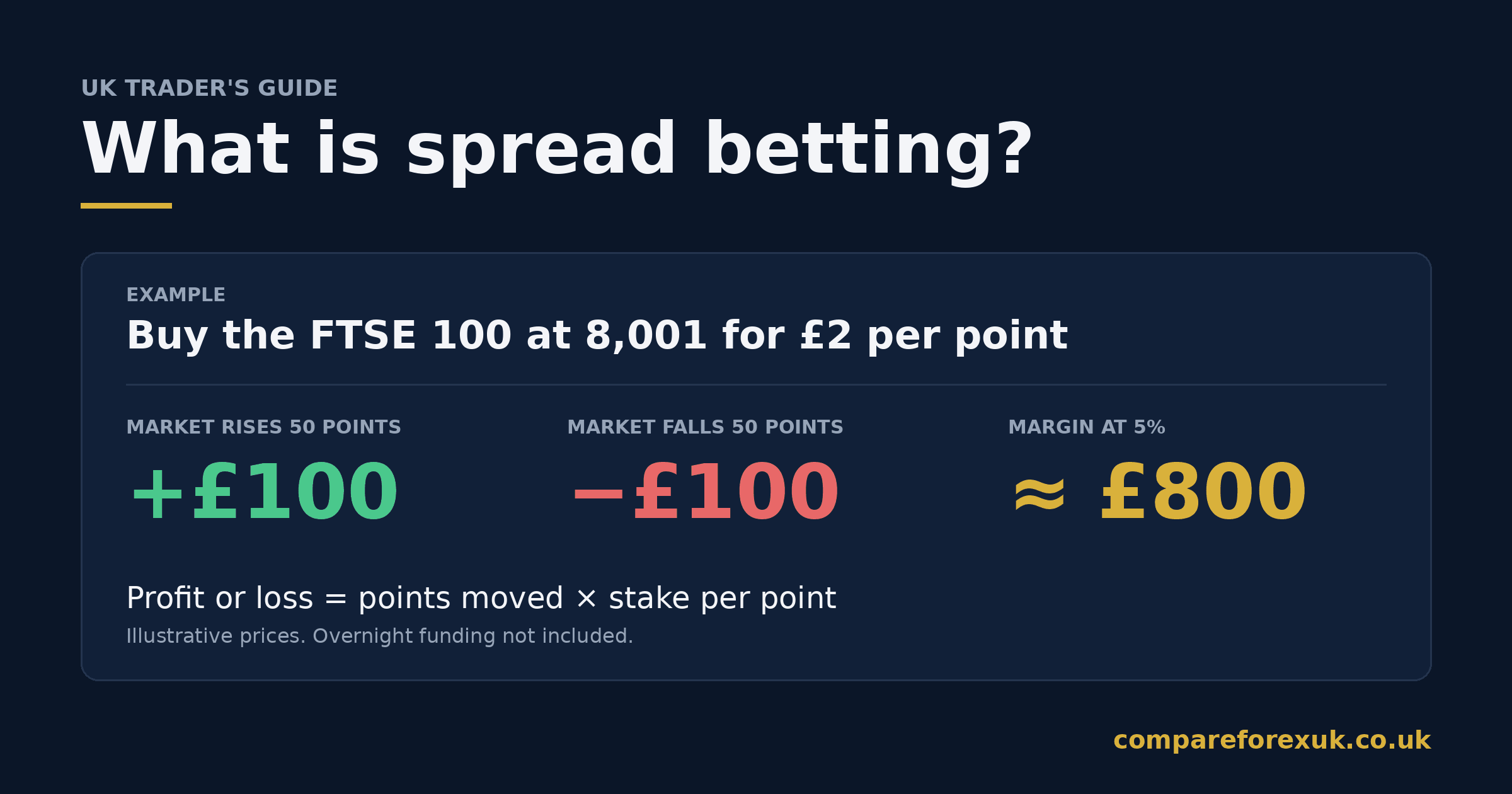
The FTSE 100 is quoted at 8,000 to 8,001. You think it will rise, so you buy at 8,001 for £2 per point. Your position is worth 8,001 × £2 = £16,002, but at the FCA's 5% minimum margin for major indices you only need about £800 to open it.
- The index rises and the quote moves to 8,051 to 8,052. You close by selling at 8,051: 50 points × £2 = £100 profit.
- The index falls and the quote moves to 7,951 to 7,952. You close by selling at 7,951: 50 points × £2 = £100 loss.
The 1-point spread cost you £2: the market had to rise from 8,000 to 8,001 on the sell side before you were back to zero.
Example 2: selling GBP/USD
GBP/USD is quoted at 1.2699 to 1.2700, which a spread betting platform shows as 12,699 to 12,700. You expect the pound to weaken, so you sell at 12,699 for £5 per point. The position is worth 12,699 × £5 = £63,495, and at the 3.33% minimum margin for major currency pairs you need about £2,114.
- The pound falls and you close by buying back at 12,649: 50 points × £5 = £250 profit.
- The pound rises instead and you close at 12,749: 50 points × £5 = £250 loss.
Because spread bets are always staked and settled in pounds, there is no currency conversion on your profit or loss, even on a US dollar market.
Example 3: buying a UK share
A UK share is quoted at 250p to 251p and you buy at 251 for £10 per point, where one point is one penny. The position is worth £2,510 and, at the 20% minimum margin for shares, needs about £502. If the shares rise and you close at 271, you make 20 × £10 = £200. If they fall to 231, you lose £200. Individual shares carry the highest margin because single companies can move sharply on news.
Trading currencies specifically? Our forex spread betting comparison sets out published spreads on six major pairs at eight FCA-regulated brokers, with a stake and margin calculator.
Margin and leverage under FCA rules
Spread betting is leveraged. You put down a deposit, called margin, that is a fraction of the position's full value, but your profit or loss is calculated on the full value. Since 1 August 2019, the FCA's permanent rules for retail clients have applied to spread bets as well as CFDs. They set a minimum margin for each type of market:
| Market | Minimum margin | Maximum leverage |
|---|---|---|
| Major currency pairs (for example EUR/USD, GBP/USD) | 3.33% | 30:1 |
| Major stock indices, minor currency pairs, gold | 5% | 20:1 |
| Minor stock indices, commodities other than gold | 10% | 10:1 |
| Individual shares and other markets | 20% | 5:1 |
Leverage works both ways. In Example 1, about £800 of margin controls a £16,000 position. A 5% fall in the FTSE 100, about 400 points, would cost £800, the whole of that margin. In practice you would usually be closed out before then. The same FCA rules include:
- A 50% margin close-out. If your account equity falls below half of the margin required for your open positions, the provider must close them as soon as market conditions allow. In Example 1, with only the £800 margin in the account, a fall of roughly 200 points could trigger it.
- Negative balance protection. As a retail client you cannot lose more than the funds in your spread betting account. You can still lose all of them.
- A ban on trading incentives, such as sign-up bonuses for opening or funding an account.
- A standard risk warning showing the percentage of the provider's retail accounts that lost money over the previous 12 months, updated every three months.
When it proposed these rules, the FCA estimated they could reduce retail clients' losses by between £267 million and £451 million a year.
What spread betting costs
Most spread betting providers charge no separate commission. The costs are built into the price and the funding of your position:
- The spread. The main cost, paid in effect every time you open and close a bet. It varies by market and by provider, and it can widen sharply outside main trading hours or when markets are volatile.
- Overnight funding. Most spread bets are "daily funded" or "rolling" bets with no fixed end date. Keep one open past the daily cut-off, typically 10pm UK time, and you pay a funding charge, usually a benchmark interest rate plus the provider's own charge. As an illustration, at an annual rate of 6% the £16,002 FTSE position in Example 1 would cost about £2.63 a night, or around £53 over 20 nights. Short positions can be charged differently.
- Forward or quarterly bets. An alternative for longer holding periods: these have a fixed expiry date, no daily funding charge and the funding built into a wider spread instead.
- Guaranteed stop premiums. If you use a guaranteed stop, the provider charges for it, often only if the stop is triggered.
- Account fees. Some providers charge an inactivity fee after a period without trading. Read the fee schedule before you fund an account.
Overnight funding is easy to underestimate. For a bet held for a few hours, the spread dominates. For a bet held for weeks, funding can cost more than the spread, which is why funding rates differ so much between brokers in our comparison.
Managing risk
Because losses are calculated on the full value of a position, risk management is not optional. The main tools are:
- Stop-loss orders close your bet automatically if the price reaches a level you set. A standard stop is not guaranteed: in a fast market, or if prices gap overnight or over a weekend, it can be filled at a worse price. This is called slippage.
- Guaranteed stops close your bet at exactly the level you choose, whatever the market does, in exchange for a premium. Not every provider offers them.
- Limit orders close a bet automatically when it reaches a profit target.
- Position sizing. Choose your stake from the amount you are prepared to lose, not from the margin you can afford. A £2 per point bet with a 50-point stop risks about £100; a £20 per point bet with the same stop risks £1,000.
Short positions carry an extra risk: a market can rise further than it can fall, so losses on a sell bet have no natural ceiling other than your account balance.
Is spread betting tax-free?
For most UK individuals, spread betting profits are not subject to Capital Gains Tax or stamp duty. HMRC's Capital Gains Manual (CG56105) explains that because no asset is bought or sold, "no chargeable gains or allowable losses arise from spread betting". Its Business Income Manual (BIM22015) adds that a person placing a spread bet is not normally carrying on a trade, so profits are not usually subject to Income Tax either.
The tax is not avoided altogether. Providers pay General Betting Duty to HMRC, currently 3% on their profits from financial spread bets, and that cost is reflected in their pricing.
Three caveats matter:
- Losses are not tax-deductible. Because no allowable losses arise, you cannot offset spread betting losses against gains elsewhere. With CFDs you can.
- Your circumstances matter. HMRC looks at the substance of what is done. Spread betting that forms part of an existing trade, or bets placed by a company, may be treated differently.
- Tax law can change. The position above reflects current HMRC guidance. If spread betting is a significant part of your income, take advice from a qualified tax adviser.
Is spread betting legal and regulated in the UK?
Yes. Financial spread betting is legal in the UK, and firms offering it to retail clients must be authorised by the FCA. You can check a firm's authorisation and reference number on the FCA's Financial Services Register before opening an account. Spread betting is offered almost exclusively to UK and Irish residents.
Being FCA-regulated brings several protections beyond the retail rules above:
- An appropriateness test. Before opening an account, the provider must assess whether you have the knowledge and experience to understand the risks.
- Segregated client money. Providers must hold retail clients' money separately from their own. If a provider fails, segregated money is returned to clients, less the administrator's costs, and the Financial Services Compensation Scheme may cover a shortfall of up to £85,000 for eligible clients. The FSCS does not cover trading losses.
- A route for complaints. If a dispute with an FCA-regulated provider is not resolved, you can take it to the Financial Ombudsman Service. Common complaints include positions closed when margin ran short and stops filled at a worse price than expected.
Be wary of offers to reclassify you as a professional client. Professional clients can access higher leverage, but they lose the FCA's retail protections, including negative balance protection.
Spread betting vs CFDs vs share dealing
| Spread betting | CFD trading | Share dealing | |
|---|---|---|---|
| Own the asset? | No | No | Yes |
| Sized in | £ per point | Units or contracts | Number of shares |
| Profit from falls? | Yes | Yes | No (without shorting) |
| Leverage | Yes, FCA limits | Yes, FCA limits | No |
| UK tax on profits | Normally none | Capital Gains Tax | Capital Gains Tax, dividend tax |
| Losses offsettable? | No | Yes | Yes |
| Stamp duty on UK shares | No | No | Yes, 0.5% |
| Typical use | Short-term speculation | Short-term speculation, hedging | Long-term investing |
Spread bets and CFDs are close cousins: the same markets, the same leverage limits and the same FCA protections. The differences are mainly how a position is sized, which currency it settles in and how it is taxed. Our guide to spread betting vs CFDs covers them in detail.
Advantages and disadvantages
Advantages
- Profits are normally free of Capital Gains Tax and stamp duty for UK individuals.
- You can bet on falling markets as easily as rising ones.
- Thousands of markets from one account, including indices, currencies, commodities and shares.
- Stakes and profits are in pounds, so there is no currency conversion on overseas markets.
- Small stakes are possible, which makes it easier to size positions carefully.
Disadvantages
- Leverage magnifies losses as well as gains, and most retail accounts lose money.
- Losses cannot be offset against other gains for tax.
- Overnight funding makes it expensive to hold positions for long periods.
- You own nothing: no shareholder rights and no long-term compounding of an investment.
- Prices come from the provider rather than an exchange, so spreads and execution vary between firms.
Who spread betting suits, and who it doesn't
Spread betting is designed for short-term speculation by people who understand leverage, can afford to lose the money they put in and are prepared to manage risk actively with stops and sensible stakes. UK taxpayers who would otherwise pay Capital Gains Tax on trading profits often prefer it to CFDs.
It is not a substitute for long-term investing, and it is a poor fit if you need the money for bills or savings goals, if you are likely to chase losses, or if you want to own assets and benefit from dividends over time. For that, share dealing or an ISA is the more natural route.
How to start spread betting
- Choose an FCA-authorised provider and check its reference number on the FCA Register. Compare spreads, overnight funding, platforms, guaranteed stops and fees for the markets you want to trade.
- Open a demo account and practise with virtual funds until you understand stakes, margin and stops.
- Complete the application. Expect identity checks and an appropriateness questionnaire about your knowledge and experience.
- Fund the account with money you can afford to lose.
- Start small. Use low stakes, set a stop on every bet and decide your maximum loss before you open a position.
Frequently asked questions
What is spread betting in simple terms?
Spread betting is a way to speculate on whether a financial market will rise or fall without owning it. You choose a stake in pounds per point, for example £2 per point on the FTSE 100. If the market moves 50 points in your favour you make £100; if it moves 50 points against you, you lose £100. It is leveraged, so losses can build quickly.
Is spread betting legal in the UK?
Yes. Financial spread betting is legal in the UK and can only be offered to retail clients by firms authorised by the Financial Conduct Authority. Since August 2019 the FCA has applied permanent rules to spread bets and CFDs, including leverage limits, a 50% margin close-out, negative balance protection and a standard risk warning.
Is spread betting profitable?
For most retail clients it is not. Every FCA-regulated provider must publish the percentage of its retail accounts that lose money. Among the six brokers in our spread betting comparison, between 61% and 74% of retail accounts lose money when trading spread bets and CFDs. Some traders do make money, but you should only bet what you can afford to lose.
Do you pay tax on spread betting profits in the UK?
For most UK individuals, no. HMRC's Capital Gains Manual (CG56105) states that no chargeable gains or allowable losses arise from spread betting, and there is no stamp duty because no asset is bought. The flip side is that losses cannot be offset against other gains. Tax treatment depends on your circumstances and can change.
Can you lose more than you deposit when spread betting?
Not as a retail client of an FCA-regulated firm. FCA rules require negative balance protection, which limits your losses to the funds in your spread betting account. You can still lose all of those funds, and the protection does not apply if you are classified as a professional client.
Is spread betting the same as gambling?
Legally, a spread bet is a bet, which is why HMRC does not charge Capital Gains Tax on it. In practice, financial spread betting is regulated by the FCA as a financial product, not by the Gambling Commission. Sports spread betting, by contrast, is overseen by the Gambling Commission.
How much money do you need to start spread betting?
Minimum deposits among the brokers we compare range from effectively nothing to around £20, and IG has no set minimum by bank transfer. The real requirement is margin: a £2 per point bet on the FTSE 100 at 8,000 needs about £800 of margin at the FCA's 5% minimum, before allowing for losses.
What is a point in spread betting?
A point is the unit of price movement your stake is multiplied by. On an index such as the FTSE 100, one point is one index point. On UK shares it is usually one penny. On a currency pair such as GBP/USD it is usually 0.0001, which forex traders call a pip. Providers state the point size for each market.
What is the difference between spread betting and CFD trading?
Both are leveraged derivatives covered by the same FCA rules. A spread bet is staked in pounds per point and is normally free of Capital Gains Tax; a CFD is traded in units or contracts, settles in the market's currency and is subject to Capital Gains Tax, which also means CFD losses can be offset against gains.
Can I practise spread betting without risking money?
Yes. Most FCA-regulated spread betting providers offer a free demo account with virtual funds and live prices. A demo is the safest way to learn how stakes, margin, stops and overnight charges work before you put real money at risk.
Sources
- FCA: permanent restrictions on the sale of CFDs and CFD-like options to retail consumers (2019)
- FCA Handbook, COBS 22.5: restrictions on the retail marketing of CFDs and spread bets
- HMRC Capital Gains Manual, CG56105: spread betting
- HMRC Business Income Manual, BIM22015: betting and gambling
- GOV.UK: General Betting Duty rates
- Financial Ombudsman Service: spread betting and CFDs
- FCA Financial Services Register