How Fed Interest Rate Decisions Affect Gold (XAU/USD): A UK Trader's Guide (2026)
By Phillip Ashdown · Published · Updated · 13 min read

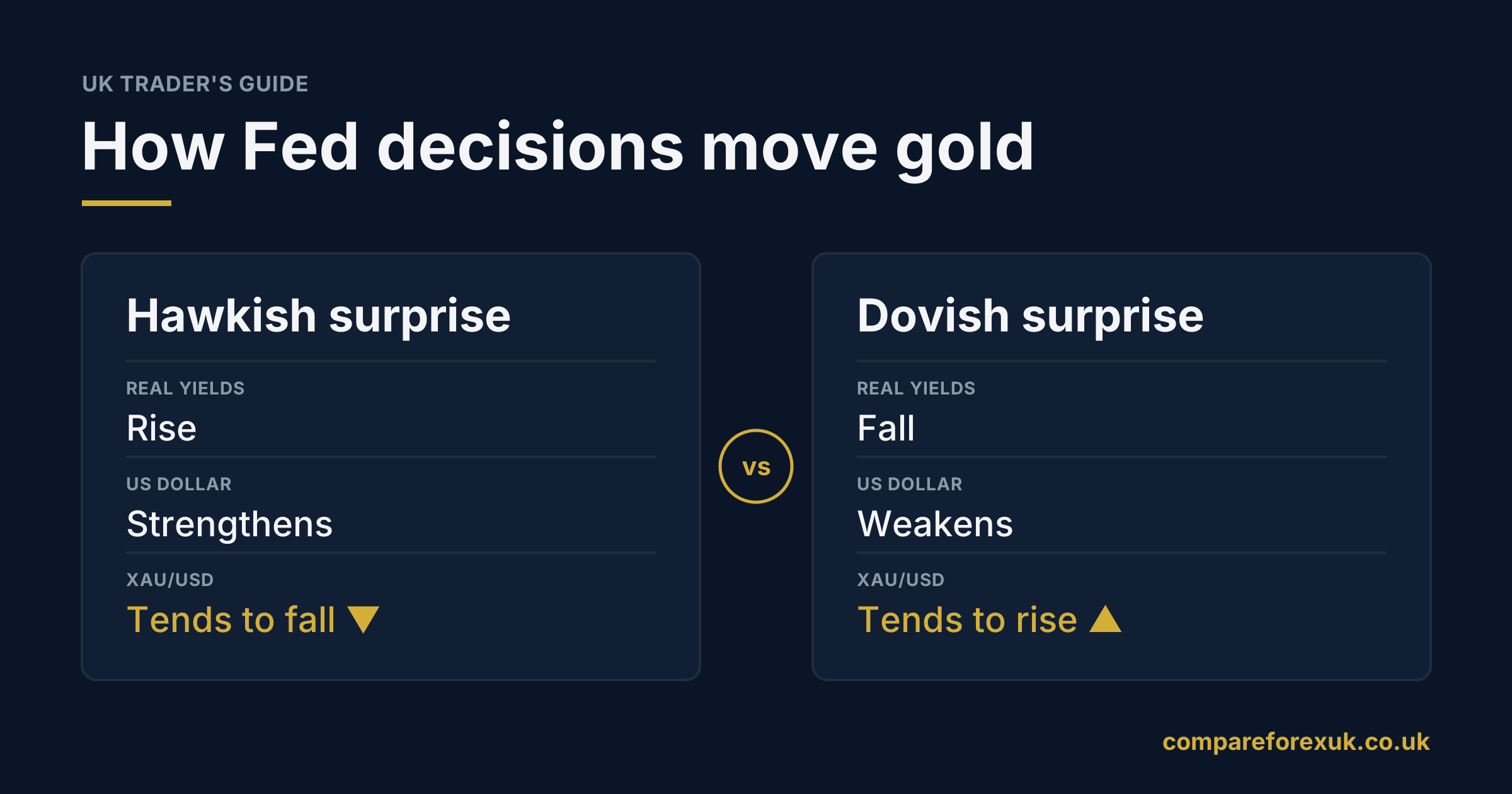
US Federal Reserve rate decisions move gold mainly through two channels: real yields and the US dollar. Gold pays no interest, so when real interest rates rise, holding it costs more in income you give up, and when they fall, gold becomes more attractive. A stronger dollar also tends to push XAU/USD down. The catch for traders is that the decision itself is usually priced in well before the announcement. What moves gold on the day is the surprise: a different rate move than expected, a shift in the projections, or a change in tone at the press conference.
Two things make this more interesting than it used to be. Since 2022, record central bank buying has weakened the link between gold and real yields, so rates now explain gold's short-term direction better than its overall level. And since Kevin Warsh became Fed chair in May 2026, the Fed has cut back on signalling its next moves, which leaves more room for surprise on decision day. This guide explains how the mechanism works, which related markets to watch, what changes for a UK trader with a sterling account, and how to manage risk around an FOMC announcement.
Key takeaways
| Point | Details |
|---|---|
| Real yields matter more than headline rates | Gold competes with the return on bonds after inflation. Falling real yields usually support gold; rising real yields usually weigh on it. |
| The surprise moves the market | Markets price in expected decisions. XAU/USD reacts to the gap between what was expected and what the Fed delivers or signals. |
| The dollar is the second channel | Gold is priced in US dollars, so a weaker dollar tends to lift XAU/USD and a stronger dollar tends to lower it. |
| The Warsh Fed says less in advance | Less forward guidance and no chair's dot in the dot plot mean fewer clues before the meeting, so decision days can carry bigger surprises. |
| The link has loosened | Heavy central bank buying since 2022 has lifted gold above where real yields alone would place it. |
| Decision days carry extra risk | Spreads can widen and prices can gap. Leverage magnifies a move that is normal for gold. |
How do interest rates affect gold?
Gold has no yield. A bar of gold or a gold position pays no interest or dividend, so the main cost of holding it is the income you could have earned elsewhere. Economists call this the opportunity cost. When cash and bonds pay little, that cost is small and gold looks attractive. When they pay a lot, the cost rises and some investors switch from gold to interest-bearing assets.
The rate that matters is the real rate, not the headline one. A real yield is the return on a bond after inflation. If a 10-year US government bond pays 4% and inflation is expected to run at 2.5%, the real yield is about 1.5%. Traders usually track the yield on 10-year US Treasury Inflation-Protected Securities (TIPS) as a direct measure.
This is why a rate cut doesn't automatically lift gold. If the central bank cuts rates because inflation is falling faster than expected, real yields may barely move. If it holds rates while inflation rises, real yields fall and gold can benefit even without a cut.
The third link is the US dollar. Interest rate decisions move currencies: higher US rates tend to attract capital into dollars. Because gold is priced in dollars, a stronger dollar makes it more expensive for buyers holding other currencies, which tends to push the dollar price of gold down.
Pro Tip: When you read about a rate decision, ask two questions: did real yields rise or fall, and did the dollar rise or fall? Those two moves explain most of gold's reaction on the day.
How does gold react to a Fed rate decision?
The decision itself is rarely the news. By the time the US Federal Reserve announces a decision, interest rate futures have usually priced the expected outcome for weeks. If the market expects a 0.25% cut and gets one, gold may barely react to the rate itself. What moves it is new information.
The Federal Open Market Committee (FOMC) meets eight times a year. Its statement is released at 2pm New York time, which is 7pm in the UK for most of the year, followed by the Chair's press conference 30 minutes later. At four of the eight meetings, the Fed also publishes its Summary of Economic Projections, including the "dot plot" of where each policymaker expects rates to go.
Gold typically reacts to four things on the day:
- A rate surprise. A cut, hold or hike that the market didn't expect moves real yields and the dollar at once, and gold reprices within seconds.
- The dot plot. If policymakers signal fewer future cuts than the market had priced, yields can rise and gold can fall even when the decision itself matched expectations.
- The statement wording. Small changes in language about inflation or the labour market can shift expectations for the next meeting.
- The press conference. Answers to questions often move markets more than the statement. Gold can reverse its first reaction within the hour.
The reaction isn't symmetrical. A 2024 study using five-minute gold futures data found that gold's returns and volatility respond more strongly to looser-than-expected Fed decisions than to tighter ones, and that the adjustment continues after the first few minutes (Awartani, Hussain and Virk, International Review of Financial Analysis). In other words, dovish surprises have tended to produce bigger and longer moves in gold.
A "hawkish hold" shows how this works. At its 18 March 2026 meeting, the Fed left rates unchanged as expected, but its more cautious tone on inflation pushed back expectations of cuts. Treasury yields and the dollar rose, and gold fell below $5,000 an ounce (InvestingCube analysis). The decision matched forecasts; the message didn't.
Pro Tip: Before a decision, check what the market is pricing, not just what economists forecast. The CME FedWatch tool shows the probability of each outcome implied by futures prices. The bigger the gap between that pricing and the result, the bigger the likely move.
What has changed under Fed Chair Kevin Warsh?
Kevin Warsh was sworn in as the Fed's 17th chair on 22 May 2026, succeeding Jerome Powell (J.P. Morgan). He has long argued that the Fed says too much about where rates are heading. At his April 2026 confirmation hearing he said he does not believe in forward guidance on interest rates tied to economic data (Wealth Professional).
His first meeting in June 2026 put that into practice. The Fed held rates, but issued a shorter statement with less forward guidance, and Warsh declined to submit his own projection to the dot plot (Chase). He also set up task forces to review the Fed's communications, balance sheet and inflation framework, and has floated holding fewer policy meetings each year.
For anyone trading XAU/USD, that matters in three ways:
- Fewer clues before the meeting. With less guidance, market expectations are less anchored, so the range of possible outcomes is wider and decision-day moves can be larger.
- Data matters more between meetings. If the Fed signals less, inflation and jobs releases, such as US CPI and non-farm payrolls, do more of the work of shaping rate expectations, and gold reacts to them accordingly.
- The dot plot may carry less weight. It still shows other policymakers' views, but without the chair's dot it is a less complete signal than it used to be.
These changes are recent and still evolving, so watch how each meeting is run as well as what it decides.
Do real yields still drive gold?
Yes, but less than they used to. From the late 1990s to 2020, inflation-adjusted gold and inverted 10-year US real yields moved together almost mechanically (Janus Henderson, June 2026). When real yields fell, gold rose, and vice versa.
Since 2022 a wide gap has opened. Gold reached new highs while real yields stayed around 2%, a combination not seen in the previous two decades. The most widely cited reason is central bank buying. Emerging market central banks bought roughly 1,000 tonnes of gold a year from 2022 to 2024, about double the 500 tonnes a year of the previous decade, as they diversified their reserves away from the dollar. That buying is less sensitive to interest rates than investor demand.
CME Group describes the relationship as not necessarily broken, but with gold's sensitivity to real rates diminished relative to other drivers (CME Group precious metals outlook 2026). Janus Henderson's analysis adds a useful nuance for traders: over shorter periods, gold still tends to fall when real yields rise and recover when they drop. Rates still explain the direction; they no longer set the floor.
For a trader, that means:
- Rate decisions still matter for short-term moves. A surprise that lifts real yields is still a headwind for gold on the day.
- Valuation models based only on rates can mislead. Gold can stay well above the level real yields alone would suggest for long periods.
- Central bank buying data is now worth watching. The World Gold Council publishes quarterly figures on official sector purchases.
How does the dollar index (DXY) affect gold?
The US Dollar Index (DXY) measures the dollar against a basket of six major currencies, led by the euro. Gold and the DXY usually move in opposite directions, partly for mechanical reasons: when the dollar falls, it takes more dollars to buy the same ounce of gold.
The strength of that inverse link varies a lot. Since 1990, the average five-month correlation between gold and the DXY has been a modest -0.39. In June 2025 it reached -0.96, one of only a handful of readings that strong in 35 years (E*TRADE from Morgan Stanley). At other times the link breaks: in January 2026, gold and the dollar index were both near multi-year highs at the same time (AHA Signals tracker). Both can rise together when investors are buying safety in general.
A correlation coefficient runs from -1 to +1. Readings beyond +0.8 or -0.8 are usually treated as strong; readings near zero mean little reliable relationship. Correlations also depend on the timeframe you measure, so a strong daily relationship can look weak on a monthly chart.
Which markets move with or against gold?
The table shows the usual direction of each relationship. None is fixed, so check the current correlation on your platform before relying on it.
| Market | Usual relationship with gold | Why |
|---|---|---|
| US Dollar Index (DXY) | Inverse | Gold is priced in dollars; a weaker dollar lifts the dollar price of gold |
| US real yields (10-year TIPS) | Inverse | Higher real yields raise the cost of holding a non-yielding asset |
| Silver (XAG/USD) | Positive, often strong | Both are precious metals driven by similar rate and dollar factors; silver usually moves more |
| Gold mining shares | Positive | Miners' profits depend on the gold price, so their shares often amplify gold's moves |
| AUD/USD | Often positive | Australia is a major gold producer, and both respond to a weaker US dollar |
| USD/CHF and USD/JPY | Often inverse | The Swiss franc and yen are also safe havens; when the dollar falls against them, gold often rises |
| S&P 500 and other stock indices | Varies | Sometimes both rise on lower rates; sometimes gold rises as a hedge when stocks fall |
Pro Tip: Correlations are also a risk check. A long gold position and a short USD/CHF position can be largely the same bet on a weaker dollar. If you hold both, your real exposure is bigger than either trade looks on its own.
What changes if you trade XAU/USD from a UK account?
XAU/USD is priced in dollars, so the Fed is the central bank that matters most for it. But if your trading account is in pounds, the product you use decides whether the exchange rate also affects your result:
- A spread bet on spot gold is usually quoted on the dollar price, with your stake in pounds per point. Moves in GBP/USD don't change your profit or loss. Our pip calculator shows what each gold pip is worth for a CFD or a spread bet.
- A CFD on XAU/USD settles in dollars, and profits and losses are converted back to pounds. Because Fed decisions also move GBP/USD, a hawkish surprise can hit a long gold CFD twice: gold falls, and the stronger dollar makes each dollar of loss worth more in pounds. A $500 loss is about £370 at a GBP/USD rate of 1.35, but about £379 if the pound has slipped to 1.32.
- A position on XAU/GBP, where your broker offers it, tracks gold's price in pounds directly. Bank of England decisions, announced eight times a year at 12 noon UK time (Bank of England MPC dates), move the pound and so feed into this price, even when XAU/USD doesn't move.
Our guide to spread betting vs CFDs explains the currency difference between the two products in more detail.
Figures are an illustration only, not a forecast.
What do past rate cycles tell us?
History shows the mechanism working, and also where it stopped working. Each episode below involved a shift in Fed policy, but what mattered for gold was the change in real yields, the dollar and who was buying.
| Period | What the Fed did | What happened to gold | The lesson |
|---|---|---|---|
| 2013 "taper tantrum" | Signalled it would slow its bond buying, pushing real yields sharply higher | Fell about 28% over the year, its worst year since 1981 | Expectations of tighter policy can hit gold before any rate rise |
| 2019 to 2020 | Cut rates, then to near zero in March 2020 | Rose to a then-record above $2,000 in August 2020 as real yields turned negative | Negative real yields remove the main cost of holding gold |
| 2022 | Raised rates by more than 4 percentage points in a year | Fell around 20% from its March high to its autumn low, then recovered | Rapid hikes and a strong dollar weighed on gold, but less than models predicted |
| 2024 | Began cutting rates in September | Set a series of record highs | Expected cuts were partly priced in before they arrived |
| 2025 to 2026 | Moved cautiously, with cuts debated meeting by meeting | Hit records while real yields stayed near 2% | Central bank buying can outweigh high real yields over long periods |
The pattern for traders: rate expectations explain a lot of gold's big moves, but the level gold settles at depends on more than rates. The 2022 episode is the turning point. Gold fell during the fastest hiking cycle in decades, but by much less than its old relationship with real yields would have implied, and then went on to new highs.
Figures are approximate and for context only. Past performance is not a guide to future returns.
How do you manage risk when trading gold around a rate decision?
The biggest risk around a decision isn't being wrong about direction. It's how leverage magnifies a move that is normal for gold. Under FCA rules, retail traders can use up to 20:1 leverage on gold, which means a 5% margin deposit.
Worked example: what a decision-day move does to your margin
Say you open a gold position worth £10,000. At 20:1, the margin required is £500. Here is what different price moves would mean:
| Gold price move | Profit or loss | As a share of your £500 margin |
|---|---|---|
| 0.5% | £50 | 10% |
| 1% | £100 | 20% |
| 2% | £200 | 40% |
| 3% | £300 | 60% |
A 1% to 2% move in gold within a few hours of a surprise decision is not unusual. On a fully leveraged position, that can wipe out a large share of your margin quickly. If your account equity falls to 50% of the margin required, an FCA-regulated broker must start closing your positions.
Figures are an illustration only. They ignore spreads, funding costs and slippage.
A checklist for decision days
- Know the time. Fed statements land at 7pm UK time for most of the year (2pm New York), with the press conference 30 minutes later. Check the dates on the Fed's FOMC calendar, as the meeting schedule may change under Chair Warsh.
- Check what's priced in. Compare market pricing, such as the CME FedWatch tool, with the consensus forecast. A big gap means a bigger potential move.
- Size the position for the move, not the margin. Decide how much you are willing to lose, then work back to a position size. Our position size calculator does the arithmetic.
- Expect wider spreads. Spreads on gold often widen in the minutes around a major release, which raises your cost of entry and exit.
- Understand your stop. A standard stop-loss can be filled at a worse price than you set if the market gaps (slippage). A guaranteed stop-loss, where your broker offers one, closes you at your exact level, usually for a premium if it is triggered.
- Avoid trading the first seconds. Prices can whip both ways before settling. Many traders wait for the press conference to finish before acting on a decision.
- Consider staying flat. Not trading a decision is a valid choice, especially if you are still learning how gold reacts.
How do you trade gold in the UK?
Most UK retail traders trade gold through a spread bet or a CFD on XAU/USD rather than buying physical bullion. Both let you go long or short around a Fed decision, with leverage of up to 20:1 under FCA rules. The main differences are tax and currency. Spread bets are staked in pounds and their profits are normally free of UK Capital Gains Tax; CFDs settle in dollars and their profits are taxed as capital gains, which also means losses can be offset. Tax treatment depends on your individual circumstances and can change. Our guide to spread betting vs CFDs covers the differences in full.
If you plan to trade gold around Fed decisions, these are the broker features worth comparing:
| What to compare | Why it matters on a Fed decision day |
|---|---|
| Spread on spot gold | Your cost to open and close; check how far it widens around the 7pm UK announcement |
| Overnight funding | Holding a leveraged gold position after the decision is charged (or credited) each night |
| Guaranteed stop-losses | Whether they are offered on gold, and the premium charged if one is triggered |
| Minimum stake or trade size | Smaller minimums make it easier to size a position for a 2% move |
| Platform tools | Price alerts, an economic calendar, and support for TradingView, MT4 or MT5 |
| FCA authorisation | Confirms client money protections; check the firm on the FCA register |
Our comparison of the best spread betting brokers in the UK sets these out side by side for FCA-regulated brokers, and our best forex brokers guide covers CFD accounts.
What I would watch before the next Fed decision
If I traded XAU/USD around an FOMC meeting, I would start a week out by checking what futures are pricing for the decision and comparing it with the latest inflation and jobs data. Under a Fed that gives less guidance, those data releases do more of the work. On the day, I would watch three things in order: real yields, the dollar index and the tone of the press conference. If all three move the same way, gold's reaction is usually clear. If they conflict, the first move often doesn't last.
Most of all, I would size the position so that a 2% move against me is a loss I can accept. That move is ordinary for gold around a surprise, and it is the leverage, not the direction, that decides whether it hurts.
Compare FCA-regulated brokers with CompareForexUK
Gold often moves sharply around Fed decisions, and spreads, guaranteed stop options and platform tools vary a lot between brokers. Our spread betting broker comparison and best forex brokers guide compare FCA-regulated brokers on cost, platforms and risk management tools.
This article contains affiliate links. CompareForexUK earns a commission when you open an account through a referral link, at no additional cost to you. Commercial relationships can affect which brokers we feature and where they appear.
Sources
- FCA Financial Services Register
- Financial Services Compensation Scheme (FSCS)
- Federal Reserve: FOMC meeting calendars
- Janus Henderson: What's behind the divergence between gold and real Treasury yields? (June 2026)
- CME Group: Precious metals outlook 2026
- Awartani, Hussain and Virk (2024): How do gold intra-day returns and volatility react to monetary policy shocks?
- E*TRADE from Morgan Stanley: Gold and the dollar correlation
- J.P. Morgan: Kevin Warsh's first Fed meeting as chair
- Chase: Key takeaways from Warsh's June 2026 Fed meeting
- Bank of England: MPC dates for 2026
- Business Standard: Gold's biggest annual loss in three decades (2013)
This article is for general information only and does not constitute financial advice. Spread bets and CFDs are complex instruments and come with a high risk of losing money rapidly due to leverage. The majority of retail investor accounts lose money when trading spread bets and CFDs. You should consider whether you understand how these products work and whether you can afford to take the high risk of losing your money. Past performance is not a guide to future returns.
Frequently asked questions
Why does gold go up when interest rates fall?
Gold pays no interest, so its main cost is the income you give up by not holding cash or bonds. When real interest rates (rates after inflation) fall, that cost shrinks and gold becomes more attractive. Lower US rates also tend to weaken the dollar, which lifts the dollar price of gold.
Does a Fed rate cut always push gold higher?
No. If a cut is fully expected, it is usually already in the price. Gold can even fall after a cut if the Fed signals fewer cuts ahead than the market expected. What matters is the surprise relative to expectations, not the decision itself.
What time is the Fed decision in the UK?
The FOMC statement is released at 2pm New York time, which is 7pm UK time for most of the year. The press conference follows 30 minutes later. For a few weeks in spring and autumn, when US and UK clocks change on different dates, the UK time is an hour earlier.
Is gold still inversely correlated with the US dollar?
Usually, but not always. Since 1990 the average five-month correlation has been about -0.39, and it has been as strong as -0.96. At times, such as early 2026, gold and the dollar have risen together. Check the current correlation before relying on it.
What changed at the Fed under Kevin Warsh?
Since becoming chair in May 2026, Warsh has reduced the Fed's forward guidance. Statements are shorter, he does not submit a projection to the dot plot, and he has floated holding fewer meetings. With fewer signals in advance, decision days can bring larger surprises.
Do Bank of England decisions affect XAU/USD?
Very little, because XAU/USD is priced in dollars. They do affect gold's price in pounds and, for CFD traders with a sterling account, the value of dollar profits and losses once converted back to pounds.
Can you spread bet on gold in the UK?
Yes. Most FCA-regulated spread betting brokers offer spot gold, usually quoted on the US dollar price with your stake in pounds per point. Retail leverage on gold is capped at 20:1. Spread betting profits are normally free of Capital Gains Tax, but tax treatment depends on your circumstances and can change.
Should you trade gold during a Fed announcement?
It depends on your experience and risk tolerance. Spreads often widen and prices can gap in the minutes around the release, so many traders reduce their position size, use guaranteed stops where offered, or wait until the press conference ends. Staying out of the market is also a valid choice.