How to Compare Forex Brokers: A UK Trader's Guide (2026)
By Phillip Ashdown · Published · Updated · 12 min read

Regulation and all-in cost are the two factors that decide which forex broker deserves your money. Before you look at anything else, verify the broker's Financial Conduct Authority authorisation on the FCA register, then calculate the total cost of your typical trade including spread, commission, and overnight swap. CompareForexUK exists precisely to speed up that process, giving you side-by-side FCA-filtered comparisons so you do not have to piece together data from a dozen separate broker websites. The short verdict: regulation is the first filter, not a tie-breaker, and no headline spread figure is meaningful until you add commissions and swaps.
Start with these three checks before anything else:
- Regulation: Confirm the broker holds a valid FCA authorisation and that the legal entity on the register matches the entity you will deposit with.
- All-in cost: Add spread + commission + typical swap for your holding period. That single number lets you compare brokers on equal terms.
- Platform and execution: Open a demo account and test order types, charting, and fill speed before committing real capital.
Pro Tip: If you hold trades overnight even occasionally, swap rates can dwarf the spread cost within a week. Run the swap calculation before you dismiss a broker as "cheap" based on its headline spread alone.
Key takeaways
Regulation and all-in cost are the two decisive factors when comparing forex brokers; verify the FCA entity first, then calculate the total cost for your specific trade size, instrument, and holding period before shortlisting any broker.
| Point | Details |
|---|---|
| Verify FCA authorisation first | Search the broker's FRN on the FCA register and confirm the entity name matches your deposit agreement. |
| Calculate all-in cost, not headline spread | Add spread, commission, and swap for your typical trade; the total often differs significantly from the advertised spread. |
| Test a withdrawal before funding fully | Make a small withdrawal early in your evaluation; processing speed and ease reveal more than any review. |
| Match broker features to your trading style | Scalpers prioritise execution and raw spreads; swing traders prioritise swap rates and support quality. |
| CompareForexUK filters by FCA status | Use our side-by-side tables to compare FCA-regulated brokers on cost, platform, and account type without building the data from scratch. |
How to compare forex brokers: a step-by-step workflow
A structured process reduces the risk of choosing a broker that looks good on paper but fails when you need to withdraw. Practical selection follows a clear order: regulator first, then total cost, then platform, then withdrawals, then support, then extras. Work through the steps below in a single session and you will have a reliable shortlist within a few hours.
- Define your trader profile. Write down your typical trade size (in lots), how long you hold positions (minutes, hours, days), which instruments you trade, and your starting capital. This profile determines which cost components matter most and which account type suits you.
- Filter by FCA authorisation. Search the FCA Financial Services Register for each broker you are considering. Confirm the firm's status is "Authorised" and note the Firm Reference Number (FRN). Reject any broker that cannot produce a valid FRN.
- Compute all-in cost for your typical trade. For each shortlisted broker, find the spread on your primary pair, add any per-lot commission, and add the daily swap rate multiplied by your average holding days. Use the same account type across every broker you compare.
- Open a demo account and test the platform. Spend at least two to three sessions on the demo. Test order entry, charting tools, mobile parity, and how the platform behaves during a news release. Note anything that slows you down.
- Check deposit and withdrawal conditions. Confirm which methods are available (bank transfer, debit card, e-wallet), whether withdrawal fees apply, and the stated processing time. Then test it: make a small deposit and request a small withdrawal before funding fully.
- Contact customer support with a specific question. Ask for the broker's FRN, the name of the bank holding client funds, and the swap rate on a specific instrument. A credible broker answers all three without hesitation.
- Score and shortlist. Weight each dimension according to your trader profile (see the trading-style section below) and keep the two or three brokers with the highest scores for a live micro-account test.
Pro Tip: If your trade frequency is high (scalping or intraday) and your holding time is short, cost dominates the decision. If you hold positions for days or weeks, swap rates and customer support quality matter far more than a 0.1-pip difference in spread. Decide which side you are on before you start scoring.
What each comparison dimension actually measures
Comparing brokers fairly means measuring the same thing across every candidate. A fair comparison restricts to brokers under the same regulatory regime and uses all-in cost rather than headline spreads. The table below shows what to measure, how to compute it, and where to find the data.
| Dimension | What to measure | How to compute it | Where to find the data |
|---|---|---|---|
| Regulation | FCA authorisation status, FRN, entity match | Look up the FRN on the FCA register; confirm the entity name matches the deposit receipt | FCA Financial Services Register |
| All-in cost | Spread + commission + swap per lot | (Spread in pips × pip value) + commission + (swap rate × days held) | Broker's trading conditions page; live platform |
| Platform | Order types, EA/API support, charting tools | Test on demo: market, limit, stop, trailing stop, OCO | Broker's platform download or web terminal |
| Execution | Fill speed, slippage, requotes | Record entry price vs. quoted price across 20+ trades | Live micro account; broker's execution statistics page |
| Account types | Raw vs standard spread, min deposit | Compare like-for-like: raw spread + commission vs standard spread, no commission | Broker's account comparison page |
| Instruments | Currency pairs, CFDs, commodities, indices | Count pairs and check exotic availability | Broker's instruments or markets page |
| Deposits/withdrawals | Methods, fees, processing time | Note fee schedule and test with a small withdrawal | Broker's funding page; live test |
| Customer support | Response time, accuracy, channel availability | Time a live chat response; ask a specific technical question | Live chat, email, phone |
Regulation and safety
Regulation determines what happens to your money if the broker fails. An FCA-authorised broker must hold client funds in segregated accounts at an approved bank, separate from the firm's own money. That segregation means your capital is not at risk if the broker becomes insolvent. Verify the FRN, confirm the entity name on the register matches the entity you are depositing with, and check that the broker's website displays the FRN prominently. If those details do not align, stop.
Trading costs in detail
The raw vs standard account distinction matters here. A raw spread account (sometimes called an ECN or commission account) charges a very tight spread, often 0.0–0.2 pips on EUR/USD, plus a fixed commission per lot, typically £2.50–£7 per side. A standard account rolls the commission into a wider spread, often 0.8–1.5 pips on EUR/USD, with no separate commission charge. Neither is universally cheaper: the right choice depends on your trade frequency and size. For high-frequency traders, raw spread accounts usually win. For lower-frequency traders who prefer simplicity, standard accounts can be more cost-effective.
Platforms and order types
MetaTrader 4 (MT4) and MetaTrader 5 (MT5) remain the most widely supported platforms among UK retail brokers. cTrader is common among ECN-style brokers and offers native depth-of-market data. Proprietary web platforms vary widely in quality. When comparing, check whether the mobile app offers the same order types as the desktop version, whether TradingView integration is available, and whether the broker supports Expert Advisors (EAs) or API connectivity if you need automated trading.
Execution quality
Execution quality is harder to measure than spread, but it matters just as much for active traders. Slippage, the difference between the price you click and the price you get, can erode profits faster than a wide spread. Requotes, where the broker rejects your order and offers a different price, are a warning sign on a platform that claims to offer instant execution. Record your entry and exit prices against the quoted price across at least 20 trades before drawing conclusions.
Pro Tip: To calculate the all-in cost per trade, use this formula: (spread in pips × pip value in £) + commission per lot + (daily swap rate × number of nights held). For a standard 1-lot EUR/USD trade with a 1.0-pip spread, a £3.50 commission, and a two-night hold at a £5.00 daily swap, the all-in cost is £10 + £3.50 + £10.00 = £23.50. Run this for your actual trade size and holding period, not a hypothetical one.
Does FCA regulation actually protect you?
Yes, and the protections are specific. An FCA-authorised broker must comply with the Client Assets Sourcebook (CASS), which requires client money to be held in segregated accounts at an approved UK bank. If the broker fails, those funds are ring-fenced and returned to clients before creditors can make claims. Retail clients also benefit from negative-balance protection, meaning you cannot lose more than you deposit, even in extreme market conditions.
The Financial Services Compensation Scheme (FSCS) provides an additional layer of protection. FSCS covers eligible claims up to £85,000 per person per firm if an FCA-authorised broker fails and cannot return client money. This is not a guarantee against trading losses, only against broker insolvency. Check the FSCS website to confirm your account type and the specific broker entity are eligible before you fund.
Quick verification checklist:
- FCA status: Search the FRN on the FCA register. Status must read "Authorised", not "Registered" or "Appointed Representative".
- FSCS eligibility: Confirm on the FSCS website that the specific broker entity is covered and that your account type qualifies.
- Segregation bank: Ask the broker which bank holds client funds. A credible broker names the bank without hesitation.
- Negative-balance protection: Confirm this is in place for retail accounts. It is a regulatory requirement for FCA-authorised brokers serving retail clients, but verify it in writing.
- Entity match: The legal entity on the FCA register must match the entity named on your deposit confirmation and account agreement.
Brokers such as Pepperstone, OANDA, IG, CMC Markets, Interactive Brokers, eToro, Forex.com, XTB, Tickmill, and Vantage all hold FCA authorisation for their UK-facing entities. That does not mean every account type or product they offer falls under FCA oversight, so always verify the specific entity and account you are opening, not just the brand name.
Regulatory note: FSCS protection applies to the FCA-authorised entity, not the brand. Some brokers operate multiple legal entities across different jurisdictions. Always confirm you are opening an account with the UK FCA entity, not an offshore subsidiary.
How to calculate the real cost of trading
Headline spreads are marketing figures. The number that matters is the all-in cost per trade for your specific profile. Brokers hide fees in several places: the spread itself, per-lot commissions, overnight swap rates, currency conversion charges when your account currency differs from the instrument's denomination, and inactivity fees if you step away from trading.
Here is where to look for each cost component on a broker's website:
- Spread: Trading conditions or instruments page; check whether the figure is typical or minimum, and whether it applies to the raw or standard account.
- Commission: Account types page or the fee schedule; confirm whether the figure is per side or per round turn.
- Swap rates: Usually found in the platform itself (right-click a symbol in MT4/MT5 and select "Specification") or on the broker's instruments page. Swap rates change frequently, so check them in the platform rather than relying on a static webpage.
- Currency conversion fee: Funding and withdrawal page; applies when you deposit in GBP but trade instruments denominated in USD or EUR.
- Inactivity fee: Terms and conditions; typically triggered after 12 months of no trading activity.
Three worked examples
Scalper (EUR/USD, 10 lots, held 2 minutes): Raw account: 0.1-pip spread × £10 pip value × 10 lots = £10 spread cost + £35 commission (£3.50 per side × 10 lots) = £45 total. No swap applies. Standard account: 1.0-pip spread × £10 × 10 lots = £100 spread cost, no commission. The raw account is £55 cheaper per trade at this size.
Intraday trader (GBP/USD, 2 lots, held 6 hours, closed before rollover): Raw account: 0.2-pip spread × £10 × 2 lots = £4 + £14 commission = £18 total. No swap. Standard account: 1.2-pip spread × £10 × 2 lots = £24, no commission. Raw account saves £6 per trade.
Swing trader (XAU/USD gold, 1 lot, held 4 nights): Standard account: 0.3-pip spread equivalent + no commission = £3 spread cost. Daily swap: £8 per night × 4 nights = £32. All-in cost: £35. The swap dominates. For swing traders, the swap rate matters far more than the spread.
These examples show why comparing brokers on spread alone misleads you. Run the same calculation for your own trade size, instrument, and holding period before making any decision.
How to test trading platforms and execution quality
A demo account tells you whether a platform suits your workflow. A small live account tells you whether the broker's execution matches what the demo showed. Both tests are necessary, and neither takes more than a week to complete.
- Download or open the platform. Test MT4, MT5, cTrader, or the broker's proprietary platform. Open the web version and the mobile app alongside the desktop version and check that the same order types are available on all three.
- Test order entry under pressure. During a scheduled news release (a US Non-Farm Payrolls announcement, for example), place a market order and record the fill price against the quoted price. Slippage during news events reveals how the broker manages liquidity.
- Check charting tools. Confirm that your preferred indicators are available, that chart data loads without gaps, and that the timeframes you use are all present. For TradingView users, check whether the broker offers native TradingView integration rather than a separate charting window.
- Test EA or API connectivity. If you run automated strategies, connect your EA to the demo account and run it for at least 48 hours. Check the broker's VPS hosting options and whether the server location minimises latency to the broker's execution server.
- Record 20 live micro-trades. Open a live account with the minimum deposit (often £100–£200 for brokers like Pepperstone, XTB, or Tickmill). Place 20 small trades across different sessions (London open, New York open, Asian session) and record the quoted price, fill price, and time to fill for each.
- Request a withdrawal. Before funding fully, withdraw a small amount (£20–£50) and time the process from request to receipt. This single test reveals more about a broker's reliability than any review.
- Contact support twice. Ask a simple question (account funding methods) and a technical question (swap rate on XAU/USD for a short position). Rate the accuracy and speed of both responses.
Pro Tip: For scalpers and EA users, the physical distance between your server and the broker's execution server affects fill speed. Ask the broker which data centre their execution server uses (LD4 in London is common for UK-facing brokers) and consider a VPS hosted in the same facility. A 1-millisecond latency difference is irrelevant for manual traders but meaningful for high-frequency EAs.
A reproducible two-week testing protocol
Running a structured test across two brokers simultaneously removes time-of-day bias and gives you directly comparable data. Open accounts with two brokers on the same day, fund both with the same amount, and run identical trades on both during the same market sessions.
Week 1: Demo and setup
- Day 1–2: Open demo accounts with both brokers. Explore the platform, test order types, and confirm EA connectivity if relevant.
- Day 3–4: Place 10 demo trades on each broker during the London session. Record spread at entry, fill speed, and any platform issues.
- Day 5: Request account opening documents from both brokers and compare the entity names against the FCA register.
Week 2: Small live account
- Day 8: Fund both live accounts with the minimum deposit. Place 5 micro-trades on each during the New York open.
- Day 10: Request a small withdrawal from both brokers on the same day. Record the date of request and the date funds arrive.
- Day 12: Contact support on both brokers with the same technical question. Record response time and accuracy.
- Day 14: Review your data and score each broker.
Pro Tip: Run both broker tests during the same news events. If you test Broker A during a quiet Asian session and Broker B during a volatile London open, your slippage data is not comparable. Schedule your test trades at identical times on both accounts.
A comparison table template you can use today
Copy the structure below into a spreadsheet and fill each cell using the broker's own published data, verified against the FCA register and the broker's live platform. Every figure should carry a date stamp, because spreads and swap rates change.
Worked example row (using publicly verifiable values):
An FCA-authorised broker with a raw account might show: EUR/USD all-in cost of 0.8 pip equivalent (0.1-pip spread + £3.50 commission per side on a standard lot), MT5 and web platform, minimum deposit of £100, GBP account currency, 70+ currency pairs, card and bank transfer withdrawals processed within 1–3 business days, and a XAU/USD long swap of approximately £5 per night per lot. Verify every figure on the broker's live platform on the day you compare, not from a cached review page.
Verification checklist for each cell:
- FRN and entity name: FCA Financial Services Register
- FSCS eligibility: FSCS website
- Spread and commission: Broker's trading conditions page and live platform
- Swap rates: Platform symbol specification (right-click in MT4/MT5) or broker's instruments page
- Withdrawal details: Broker's funding page and live test
Pro Tip: Date-stamp every cell when you fill it in. Spreads and swap rates change without notice, and a comparison table that is three months old may show figures that no longer apply. Add a "Last verified" row and update it each time you revisit the comparison.
Red flags to watch for before you fund
Most broker problems are visible before you deposit a single pound. The warning signs below are consistent across the brokers that generate the most complaints to the FCA.
Structural red flags:
- No FRN displayed on the website, or the FRN does not appear on the FCA register when you search it.
- The legal entity on the website differs from the entity on the FCA register.
- The broker asks you to send funds to a different legal entity than the one you signed up with.
- No published fee schedule, or fees described only as "competitive" without specific figures.
- No demo account available, or the demo account uses different spreads than the live account.
- Withdrawal requests require you to contact a personal account manager rather than using a self-service portal.
- Bonus offers that tie your funds to a trading volume requirement before withdrawal is permitted.
Questions to ask before funding:
- "What is your FCA Firm Reference Number, and which legal entity will hold my funds?"
- "Which bank holds your client money, and is it held in a segregated account?"
- "What is the typical processing time for a card withdrawal, and are there any fees?"
- "What is the current swap rate for a long XAU/USD position held overnight?"
- "If I have a complaint, what is the process and which ombudsman can I escalate to?"
A broker that hesitates, deflects, or gives vague answers to any of these questions is telling you something. Escalate to the FCA if a broker asks you to route funds to a different legal entity, refuses to confirm segregation details, or delays a withdrawal without a clear explanation. The FCA's consumer helpline handles exactly these situations.
Which features matter most for your trading style
Different trading styles place very different demands on a broker. The priority stack below shows which dimensions to weight most heavily for each archetype. Use it as a starting point for your scoring matrix.
Scalper (holds positions for seconds to minutes):
- Execution speed and slippage: the most critical factor. Even 0.2 pips of consistent slippage destroys a scalping edge.
- Raw spread and commission: total cost per trade must be as low as possible given high trade frequency.
- Latency and server location: ask whether the broker's execution server is in LD4 (London) or NY4 (New York).
- Accept: slightly higher minimum deposit for a raw account; fewer research tools.
Intraday trader (holds for minutes to hours, closes before rollover):
- All-in cost: spread plus commission, since swap rarely applies.
- Platform stability: the platform must not freeze or lag during London and New York sessions.
- Order types: one-cancels-other (OCO) orders and guaranteed stops are useful for intraday risk management.
- Accept: moderate swap rates, since positions close before rollover.
Swing trader (holds for days to weeks):
- Swap rates: the dominant cost for multi-day positions. Compare swap rates on your primary instruments before anything else.
- Customer support quality: you may need to contact the broker about a position held over a weekend or a corporate action.
- Instrument range: swing traders often trade multiple asset classes (forex, gold, indices), so instrument breadth matters.
- Accept: slightly wider spreads, since the entry cost is amortised over a longer holding period.
Investor or position trader (holds for weeks to months):
- Swap rates and financing costs: these accumulate significantly over long holding periods.
- Regulation and FSCS protection: capital is at risk for longer, so the strength of the regulatory framework matters more.
- Instrument range and research tools: access to economic calendars, analyst reports, and fundamental data supports longer-term decisions.
- Accept: higher spreads, since trade frequency is low.
EA or algorithmic trader:
- API and EA support: confirm MT4/MT5 EA compatibility, VPS hosting options, and FIX API availability.
- Execution model: an ECN or STP model with no dealing desk reduces the risk of order manipulation.
- Uptime and server reliability: ask for the broker's historical uptime statistics.
- Accept: slightly higher commission if execution quality and API reliability are strong.
Do not average the weights across archetypes; decide which style generates the most of your P&L and weight accordingly.
How to judge whether a broker review is trustworthy
Third-party broker reviews vary enormously in quality. Many are written by affiliates who earn a commission when you sign up, which creates an obvious incentive to present every broker favourably. That does not make affiliate reviews useless, but it does mean you need to read them critically.
Trust signals in a credible review:
- Published methodology: The review explains how spreads were measured (live data, time of day, account type) and when the test was conducted.
- Live spread testing: Figures come from a live account or a verified data source, not from the broker's marketing page.
- Withdrawal test: The reviewer tested a real withdrawal and reported the outcome, including any delays or fees.
- Regulator check: The review confirms the FCA entity name and FRN, not just the brand name.
- Date of last update: Broker conditions change. A review without a clear update date may reflect conditions that no longer exist.
- Affiliate disclosure: A credible review discloses the affiliate relationship clearly, usually at the top of the page. The absence of a disclosure is itself a warning sign.
Broker directories such as Myfxbook provide searchable filters for spreads, regulation, and trading conditions, which are useful for cross-checking broker disclosures against independently aggregated data.
Brokers including Pepperstone, OANDA, IG, CMC Markets, Interactive Brokers, eToro, Forex.com, XTB, Tickmill, and Vantage appear across most credible UK review sites. Their presence on multiple independent platforms is a positive signal, but it does not replace your own verification of the FCA entity and your own cost calculation.
What I would do next if I were starting this process today
If I were sitting down to compare forex brokers right now, the first thing I would do is open the FCA register and search the FRN for every broker on my list. Any broker that fails that check is gone immediately, regardless of how attractive its spreads look. Regulation is not a formality; it is the difference between having legal recourse and having nothing if something goes wrong.
After that, I would calculate the all-in cost for my specific trade profile, not a hypothetical one. I would use the formula above: spread in pips multiplied by pip value, plus commission, plus swap multiplied by my average holding days. I would run that number for my three most-traded instruments on each shortlisted broker, using the raw account figures where available.
Then I would open two demo accounts simultaneously, run the two-week protocol above, and make a small withdrawal from each broker before funding fully. The withdrawal test is the one step most traders skip, and it is the one that reveals the most. A broker that processes a £50 withdrawal cleanly and promptly is a broker that will handle a £5,000 withdrawal the same way.
Compare FCA-regulated brokers with CompareForexUK
Pulling together FCA entity names, spread data, commission schedules, and swap rates from a dozen broker websites takes hours. CompareForexUK cuts that time significantly by presenting side-by-side comparisons of FCA-regulated brokers, filtered by the criteria that matter most to UK traders: regulation status, all-in cost, platform availability, minimum deposit, and instrument range.
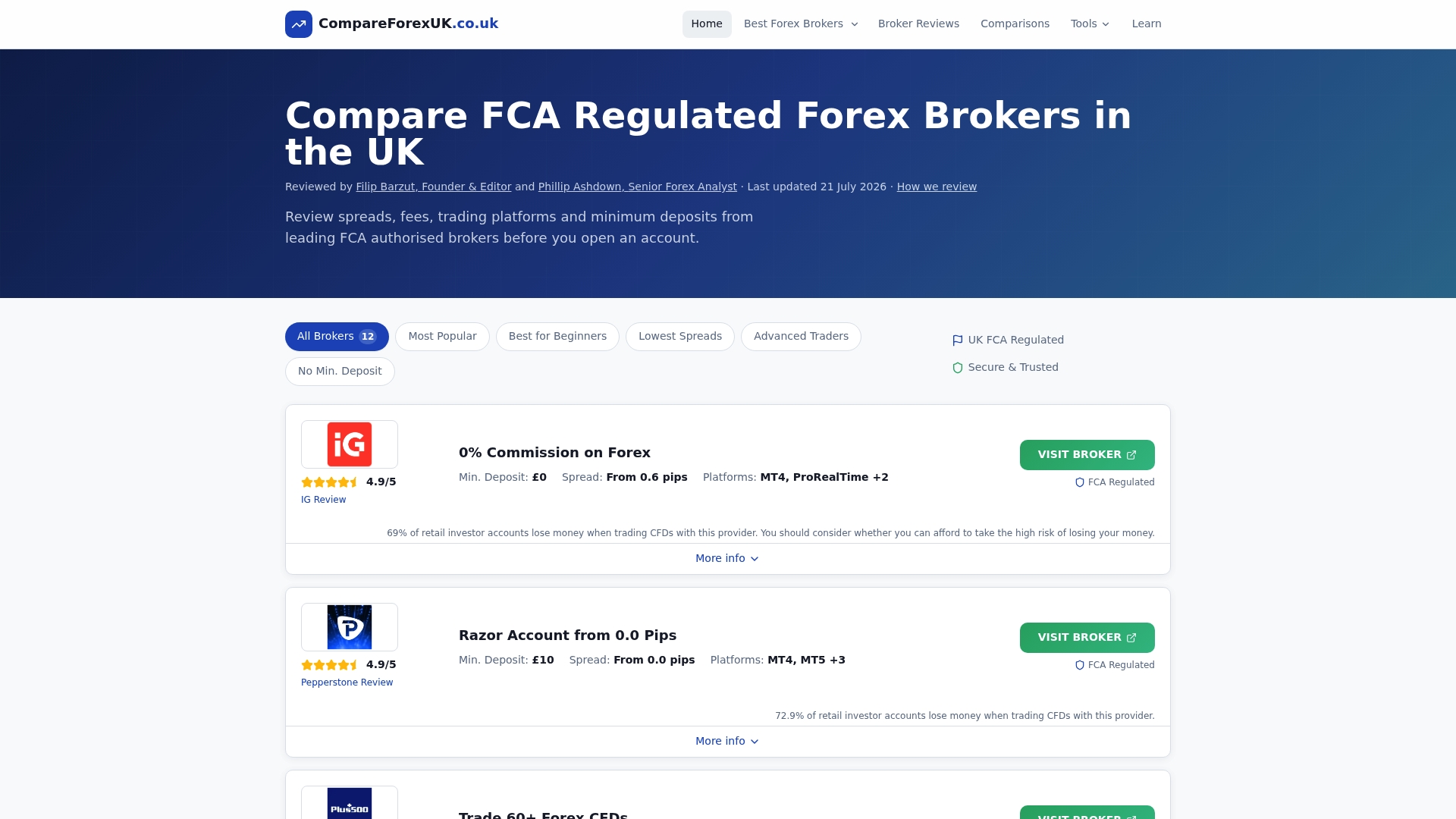
Our comparison tables are built around the same framework described in this guide, so you can move directly from reading to comparing without rebuilding the data yourself. Every broker listed on CompareForexUK holds FCA authorisation, which means the first filter is already applied. From there, you can narrow by account type, cost, and platform to match your trader profile, or dig into a head-to-head comparison of two shortlisted brokers.
This article contains affiliate links. CompareForexUK earns a commission when you open an account through a referral link, at no additional cost to you. That relationship does not affect which brokers are listed or how they are presented; FCA authorisation is a non-negotiable requirement for inclusion.
Compare FCA-regulated brokers now and apply the checklist from this guide to your shortlist.
Sources
The links below are the primary sources you should use to verify broker claims independently. Keep them bookmarked and check them each time you update your comparison table.
- FCA Financial Services Register — verify FRN, authorisation status, and legal entity name.
- Financial Services Compensation Scheme (FSCS) — confirm compensation eligibility for your account type and firm.
- How to Choose a Forex Broker: The 2026 6-Step Checklist
- Myfxbook — Forex Brokers directory
This article is for general information only and does not constitute financial advice. Forex and CFD trading carries significant risk and is not suitable for all investors; the majority of retail investor accounts lose money. Verify all regulatory and cost information directly with the broker and the FCA before opening an account, and consult a qualified financial professional about your own circumstances before acting on anything here.
Frequently asked questions
How do you compare forex brokers?
Work through a fixed order: confirm FCA authorisation first, then calculate the all-in cost (spread + commission + swap) for your typical trade, then test the platform and execution on a demo, then make a small live withdrawal, and finally judge customer support. Score each broker against your own trading style rather than a generic weighting.
Does FCA regulation protect your money?
Yes. An FCA-authorised broker must hold client money in segregated accounts at an approved UK bank under the Client Assets Sourcebook (CASS), so your capital is ring-fenced if the firm becomes insolvent. Retail clients also get negative-balance protection, and the FSCS may compensate eligible claims up to £85,000 per person per firm if the broker fails.
What is the all-in cost of a forex trade?
It is spread plus commission plus overnight swap for your specific trade, not the headline spread alone. Calculate it as (spread in pips × pip value) + commission per lot + (daily swap × nights held). Running this for your real trade size and holding period is the only way to compare brokers on equal terms.
Is a raw spread or standard account cheaper?
Neither is universally cheaper. Raw (ECN/commission) accounts charge a very tight spread plus a fixed commission and usually win for high-frequency traders; standard accounts fold the cost into a wider spread with no commission and can suit lower-frequency traders. Compare them like-for-like at your actual trade size before deciding.
What red flags should you check before funding a broker?
Walk away if there is no FRN on the FCA register, if the legal entity on the website differs from the one on the register, if you are asked to send funds to a different entity, if there is no published fee schedule, or if withdrawals require going through a personal account manager. Vague answers to direct questions about client-money segregation and the FRN are themselves a warning sign.